Jun 26, 2026News & Insights
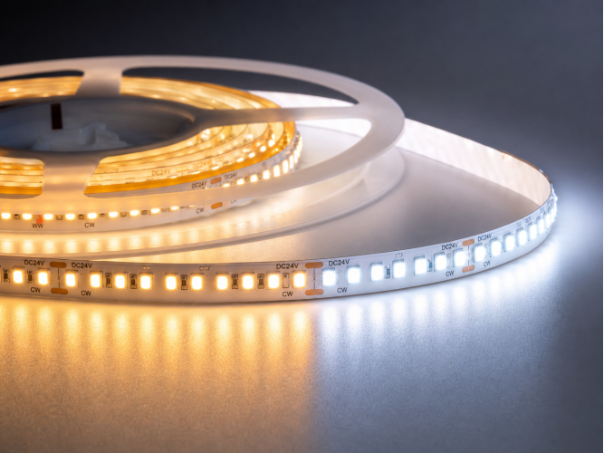
Dual Color Temperature LED Strip
Two-Wire vs. Three-Wire Differences
Dual Color Temperature LED Strip: Two-Wire vs. Three-Wire Differences | Engineering Procurement and Matching Guide
Introduction
In modern lighting engineering, dual color temperature LED strips are widely favored for their ability to flexibly adjust warm and cool light colors to suit different scene atmospheres. However, in actual engineering procurement and application, many professionals often encounter problems such as incompatible controllers, project delays, and even increased costs due to a lack of clear distinction between the underlying technical differences of two-wire dual color temperature LED strips and three-wire dual color temperature LED strips. This article aims to deeply analyze the working principles, advantages, disadvantages, and applicable scenarios of these two types of LED strips, and to provide a detailed engineering procurement and matching guide to help lighting engineers avoid common pitfalls and ensure successful project implementation.
I. Technical Principles and Differences of Two-Wire and Three-Wire Dual Color Temperature LED Strips
The core function of dual color temperature LED strips is to achieve color temperature adjustment, i.e., stepless or stepped switching between cool white light and warm white light. There are two main technical approaches to achieve this function, corresponding to two-wire and three-wire LED strip structures.
1.1 Three-Wire Dual Color Temperature LED Strip: Mainstream and High-Performance Choice
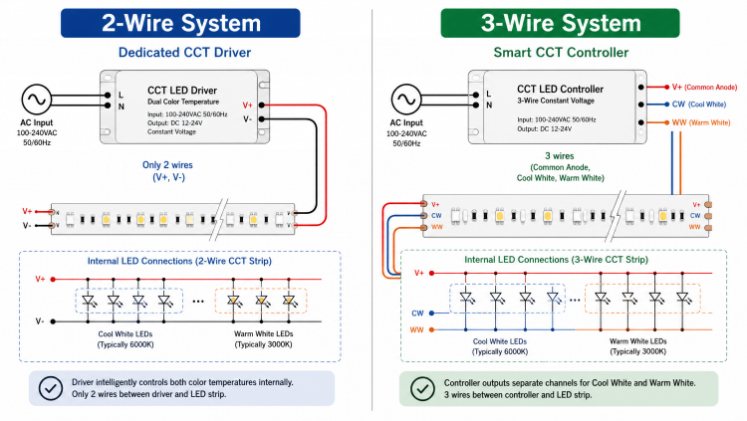
A three-wire dual color temperature LED strip typically consists of three wires, one of which is a common positive (or common negative) pole, and the other two are connected to the negative (or positive) poles of the cool light LED module and the warm light LED module, respectively. Its color adjustment principle is to independently adjust the intensity or duty cycle (PWM dimming) of the cool light and warm light currents through a dedicated dual color temperature controller. When the proportion of cool light current increases, the LED strip presents a cool white color; when the proportion of warm light current increases, it presents a warm yellow color. By precisely controlling the relative proportions of the two currents, stepless and smooth color temperature adjustment can be achieved.
Advantages:
- Dimming Effect: The color temperature adjustment process is smooth and delicate, without obvious jumps, and is less prone to flicker, providing a better visual experience.
- Color Temperature Accuracy: Due to independent control of cool and warm light paths, the color temperature output is more stable and accurate.
- Compatibility: It has extremely high controller compatibility and can adapt to most mainstream smart lighting systems on the market, such as DALI, DMX512, Zigbee, 0-10V dimming power supplies, etc., making it easy to integrate into complex smart home or building control systems.
- Stability: The circuit design is mature, usually with international certifications such as UL, CE, and SAA, making it suitable for large public buildings and municipal lighting projects that require high stability.
Disadvantages:
- Wiring Requirements: Requires three-core wires for connection, which is slightly more complex than two-wire systems.
1.2 Two-Wire Dual Color Temperature LED Strip: Simplified and Retrofit Solution
A two-wire dual color temperature LED strip has only two wires (positive and negative), and its internal cool and warm LED modules are designed in the same circuit. To achieve color temperature adjustment on two wires, the following two technical solutions are usually adopted:
- Polarity Switching Method: The controller rapidly switches the polarity of the output voltage, utilizing the unidirectional conductivity of LEDs to illuminate cool or warm LED modules separately under different polarities. By adjusting the frequency and duty cycle of polarity switching, color temperature adjustment is achieved.
- Signal Modulation Method: A specific high-frequency signal is superimposed on the DC power supply line. The decoding chip integrated inside the LED strip can identify these signals and control the brightness of the cool and warm LED modules according to the signal instructions, thereby achieving color temperature adjustment.
Advantages:
- Simplified Wiring: Only two wires are needed, which is particularly suitable for old building renovation projects, eliminating the need to re-lay multi-core cables and allowing direct use of existing single-color LED strip wiring.
Disadvantages:
- Controller Matching: Must be used with dedicated two-wire dual color temperature controllers and power supplies. If mistakenly connected to a three-wire controller, it may cause the LED strip to light up only one color, not light up at all, or even burn out the internal driver chip, resulting in extremely poor compatibility.
- Dimming Effect: Due to the limitations of its color adjustment principle, the dimming transition may not be as smooth as that of the three-wire system, and some products may have slight flicker.
- Visual Quality: Color temperature accuracy is relatively low, prone to color shift, and the visual quality is generally mediocre.
1.3 Summary of Two-Wire vs. Three-Wire Dual Color Temperature LED Strips
The table below details the differences between two-wire and three-wire dual color temperature LED strips in key technical indicators:
Dimension | Three-Wire Dual Color Temperature LED Strip (Common in Engineering) | Two-Wire Dual Color Temperature LED Strip (Simplified for Retrofit) |
Circuit Structure | 1 common terminal (positive/negative) + 1 cool light control wire + 1 warm light control wire | Only 2 wires (positive and negative) |
Dimming Principle | Independent adjustment of cool and warm light current ratio (PWM) | Rapid polarity switching or signal modulation |
Dimming Effect | Stepless dimming, smooth, accurate color temperature, no flicker | Transition may be stiff, slight flicker possible, general color temperature accuracy |
Controller Compatibility | Extremely wide, compatible with mainstream smart systems like DALI, DMX512, Zigbee, 0-10V | Extremely narrow, must be paired with dedicated two-wire driver/controller |
Installation Scenarios | New installations, high-end projects, smart lighting, places with high demands for light quality | Old building retrofits, scenarios where re-wiring is not possible, high demand for cost-effectiveness and ease of installation |
Visual Quality | SDCM < 3, high color consistency, no green or purple tint | Prone to color shift, general color consistency |
II. Engineering Procurement and Matching Guide for Dual Color Temperature LED Strips
Correct procurement and matching are crucial for ensuring the quality of lighting projects and avoiding rework. The following are key points and matching recommendations for engineering procurement of dual color temperature LED strips:
2.1 Clarify Project Requirements and Application Scenarios
Before procurement, it is essential to clarify the specific project requirements and application scenarios:
- New Projects or Smart Integration: If the project is a new installation and plans to integrate into a smart home or building control system, it is highly recommended to choose a three-wire dual color temperature LED strip. Its excellent compatibility and dimming performance can better meet the needs of smart control.
- Old Building Retrofit Projects: If the renovation is based on existing wiring and re-laying cables is not possible, a two-wire dual color temperature LED strip may be the only option. However, its compatibility limitations must be noted, and dedicated drivers and controllers must be purchased.
- Light Quality Requirements: For commercial retail, medical rehabilitation, and other places with extremely high demands for light quality (e.g., color rendering index, color temperature stability, no flicker), priority should be given to high-quality three-wire LED strips.
2.2 Key Technical Parameters to Consider
- PCB Copper Thickness: For long-distance installations of LED strips, voltage drop is a key issue leading to uneven brightness and color shift at the end. In engineering projects, it is recommended to choose LED strips with 2oz or 3oz thick copper PCBs. Thicker copper foil can effectively reduce circuit resistance and voltage drop, ensuring consistent brightness and color temperature from beginning to end.
- Color Rendering Index (CRI): CRI is an important indicator of a light source's ability to restore the true colors of objects. For commercial spaces (e.g., jewelry stores, fashion stores, exhibition halls), it is recommended to choose LED strips with Ra>90, and even for special applications (e.g., museums, art galleries), R9>50 high CRI LED strips may be required to ensure accurate color presentation of goods.
- Color Consistency (SDCM): SDCM (Standard Deviation of Color Matching) is used to measure the color consistency of light sources. In engineering projects, it is recommended to choose LED strips with SDCM < 3 to avoid noticeable color differences between different batches or sections of LED strips, which would affect the overall visual effect.
- Power and Brightness: Select appropriate power density (W/m) and lumen output based on actual lighting needs. At the same time, consider the heat dissipation performance of the LED strip to ensure long-term stable operation.
2.3 Driver and Controller Matching Strategy
Drivers and controllers are core components of dual color temperature LED strip systems, and their matching is crucial:
- Three-Wire LED Strips: Due to their wide compatibility, mainstream controllers with DALI, DMX512, Zigbee, 0-10V, and other protocols can be selected. When choosing a controller, consider its dimming curve, scene preset functions, and integration capabilities with the overall smart system. Renowned brands such as LTECH, Sunricher, Euchips, and Skydance all offer high-performance controller products.
- Two-Wire LED Strips: Must be used with dedicated drivers and controllers provided by the LED strip manufacturer. Do not attempt to mix with three-wire controllers, as this may lead to equipment damage or functional failure.
- Power Calculation: The total output power of the driver must be greater than the total power of the connected LED strips. It is generally recommended to reserve a 20% margin for driver power, i.e.: Driver Power = LED Strip Power per Meter × Total Length of LED Strip × 1.2. This helps extend the life of the driver and cope with possible voltage fluctuations.
2.4 Product Certification and Brand Selection
- International Certifications: In engineering projects, international certifications such as UL, CE, and SAA for LED strips are important guarantees of product quality and safety, and are also necessary conditions for project acceptance. Choosing products with these certifications can effectively reduce future maintenance costs and risks.
- Brand Reputation: Choose brand suppliers with a good market reputation and rich engineering experience, such as Mingxue Optoelectronics, Opple, and NVC. These brands generally provide stronger guarantees in product research and development, quality control, and after-sales service.
Conclusion
Dual color temperature LED strips, as an important component of modern lighting, have significant differences in technical principles, performance, and applicable scenarios between two-wire and three-wire systems. Three-wire LED strips, with their excellent dimming effect, accurate color temperature, and wide compatibility, are the preferred choice for new projects and high-end smart lighting engineering; while two-wire LED strips, with their simple wiring advantages, play a role in old building renovation projects, but their dedicated driver matching must be strictly noted. By deeply understanding these differences and combining them with the engineering procurement and matching guide provided in this article, lighting engineers can more scientifically and efficiently select and apply dual color temperature LED strips, ensuring the quality and successful delivery of lighting projects.